

Over the past few weeks, I’ve been moving through Europe. Much of what makes the continent attractive is immediately visible: the public spaces, the quality of everyday life, and the sense that economic success should purchase something beyond more work.
The economy required to sustain those things is harder to see.
Europe has accumulated considerable prosperity. It also has institutions designed to distribute and protect it. The question is whether those institutions can generate enough new prosperity as the population ages and the demands on public finances increase.
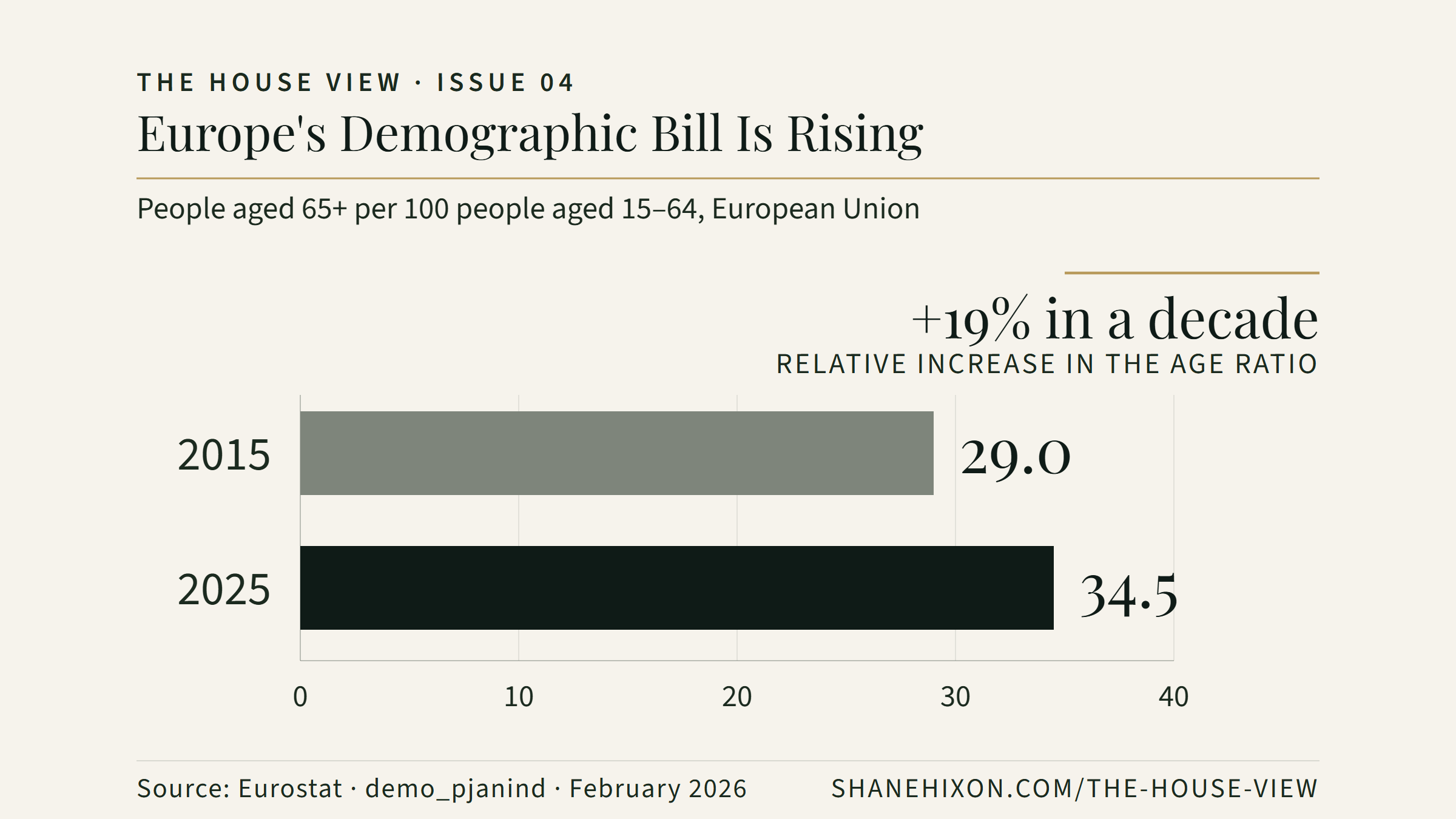
The adjustment is already underway. Eurostat reports that the EU had 29 people aged 65 or older for every 100 people aged 15–64 in 2015. By 2025, that figure had reached 34.5. The older population relative to the working-age population increased by almost 19% in a decade. These are age groups, not counts of retirees and employed taxpayers, but the direction of the pressure is clear. Eurostat, Population structure and ageing.
That makes productivity more than a competition with America. Europe needs a stronger productive base to preserve the choices it has already made.
The demographic bill is arriving
An aging population changes the relationship between the economy and the obligations built on top of it. Pension payments, healthcare and care services must be financed from current production, taxes, investment income or borrowing. Accumulated wealth provides a buffer. It does not eliminate the need to produce goods and services each year.
There are several ways to adjust. More people can enter employment. Working lives can become longer. Immigration can expand the labor pool. Governments can change taxes and benefits. Higher productivity can allow each hour worked to support more consumption.
The difficulty is that every delayed adjustment increases the demands on the others.
Show the data
| Year | Old-age dependency ratio |
|---|---|
| 2015 | 29.0 |
| 2025 | 34.5 |
EU-27 aggregate, 1 January observations. Eurostat dataset
demo_pjanind, indicator OLDDEP1, February 2026 edition. The relative
increase is 18.97%, shown as +19%; the absolute increase is 5.5
percentage points.
Download the data as CSV.
Immigration can help, but its economic contribution depends on employment, skills and integration. Longer working lives can help, but the scope varies by occupation and health. Higher taxes can raise revenue, but they also change incentives and the distribution of the adjustment.
Productivity creates room to make those choices less painful. A more productive economy can support higher living standards without requiring an equivalent increase in working hours.
The problem is that Europe needs this room after years of disappointing performance.
The growth problem is inside the market
In a June 2025 assessment, the IMF put EU total factor productivity roughly 20% below the U.S. level. That measure concerns how effectively an economy combines labor and capital. It is distinct from output per worker and from the number of hours people choose to work. IMF, Europe’s Integration Imperative.
The distinction matters. Leisure is a legitimate use of prosperity. Weak productivity makes that leisure harder to finance.
Europe’s economic size should be an advantage. A company with a good product should be able to spread development costs across a large customer base, attract financing and expand. Yet entering another European market can still require navigating different administrative procedures, legal arrangements and national requirements.
An IMF working paper identifies fragmented regulation, financial intermediation, labor mobility and energy markets as four constraints on European companies’ ability to expand across borders. IMF, Lifting Binding Constraints on Growth in Europe.
Those constraints reinforce one another. A smaller accessible market reduces the potential return on developing a product. That makes financing harder to justify. Limited financing slows expansion and investment. The resulting business remains less able to absorb the fixed costs of new technology.
The cost of fragmentation therefore extends beyond paperwork. It changes which investments happen.
A rule can be defensible in isolation while the system surrounding it discourages expansion. The relevant economic test is whether the combined framework allows productive companies to grow, compete and replace less productive activity.
Protecting the existing arrangement has a cost when the arrangement no longer produces enough growth.
Savings need a route into expansion
Europe has substantial financial resources. When the European Commission introduced its Savings and Investments Union strategy in March 2025, it identified roughly €10 trillion in EU household bank deposits. European Commission, Savings and Investments Union.
Deposits are not money removed from the economy. They help fund bank lending and provide households with liquidity and security. Moving them into equities would not automatically create productive investment.
The issue is the financing available for different kinds of risk.
A bank can lend against an established business with predictable cash flow and collateral. A young company developing software or a new industrial process may have neither. Its financing requires investors willing to absorb losses in exchange for a share of an uncertain future business.
That is why deep equity markets matter. They provide a different kind of capital, with a different tolerance for uncertainty.
The return also depends on what happens after the money is raised. Investors need companies that can reach customers, hire people and expand across borders. Financial integration and market integration work together. Improving one while leaving the other fragmented limits the payoff.
Europe’s savings are an advantage. The investment case improves when those savings can finance businesses capable of becoming much larger.
Energy sets the hurdle rate
Expansion also requires competitive operating costs.
A December 2025 European Commission document reported that EU industrial retail electricity prices in the second quarter of 2024 were 2.2 times those in the United States. That is a dated comparison, rather than a claim about every company’s current contract, but it illustrates the disadvantage facing energy-intensive investment. European Commission, European Grids Package communication.
A factory is an investment in decades of future production. Its location depends partly on what electricity will cost, whether supply is reliable, and how quickly new capacity can connect. Subsidies can offset some of those costs. They also shift part of the bill onto public finances.
The productive response requires generation, transmission, storage and a market that can move electricity toward demand. Decarbonization can contribute to that response when it delivers dependable energy at competitive cost.
Announcements are easier to produce than connected capacity. The economic benefit begins when a business can actually use the power.
AI is another test of absorption
The previous issue examined the distance between technological capability and useful work. Europe faces the same problem with a demographic reason to close that distance quickly.
A comparable worker survey conducted in January and February 2026 found that 43% of U.S. workers used generative AI for their jobs, against approximately 32% across the six European countries surveyed. That European sample included the UK; it was not an EU-wide estimate. Bick and coauthors, Mind the Gap.
The evidence does not support treating Europe as uniformly reluctant. Eurostat found that AI use among enterprises in its survey rose from 13.5% in 2024 to 20.0% in 2025. Denmark reached 42%, while Romania stood at 5.2%. The survey covers specified sectors and businesses with at least ten employees or self-employed persons. Eurostat, Enterprise AI use.
Those differences weaken the idea that a single European attitude explains the outcome. They also show that faster adoption is possible within Europe’s institutional framework.
The commercial question is what adoption produces. A subscription becomes economically useful when it reduces the cost of serving a customer, improves a product, or allows a worker to complete more valuable work. Training, data quality and changes to established processes determine how much of the potential survives implementation.
Europe can capture those benefits using technology developed elsewhere. Domestic innovation matters, but a European business does not have to wait for a European frontier model before improving its operations.
The risk is another cycle in which the technology becomes available faster than the economy reorganizes around it.
Reform has to become observable
European policymakers have recognized much of this problem. The Commission’s Competitiveness Compass, introduced in January 2025, brings together proposals covering innovation, business expansion, energy costs and financial integration. Recognition has become a policy agenda. European Commission, Competitiveness Compass.
The next question is execution.
The relevant evidence would be companies expanding across borders with fewer obstacles, financing reaching productive businesses, energy projects connecting faster, and technology investment producing measurable gains in output.
Some reforms will impose visible costs before their benefits become clear. Incumbents may face more competition. Workers may need new skills. Governments may surrender control over rules they previously set nationally.
Delay can look easier because its costs arrive gradually and appear in different places: weaker wage growth, tighter public budgets, deferred investment and fewer opportunities for the next generation.
That is how Europe keeps digging. The pressures increase while the investments and reforms capable of relieving them take time to deliver.
Sources
- Eurostat, Population structure and ageing, data extracted February 2, 2026.
- Alfred Kammer, IMF, Europe’s Integration Imperative, June 2025.
- IMF Working Paper 2025/113, Lifting Binding Constraints on Growth in Europe, June 2025.
- European Commission, Savings and Investments Union, March 19, 2025.
- European Commission, European Grids Package communication, December 10, 2025.
- Alexander Bick and coauthors, Mind the Gap: AI Adoption in Europe and the US, 2026.
- Eurostat, 20% of EU enterprises use AI technologies, December 11, 2025.
- European Commission, Competitiveness Compass, introduced January 2025.