

Forty trillion dollars is not a magic number. It is a warning sign.
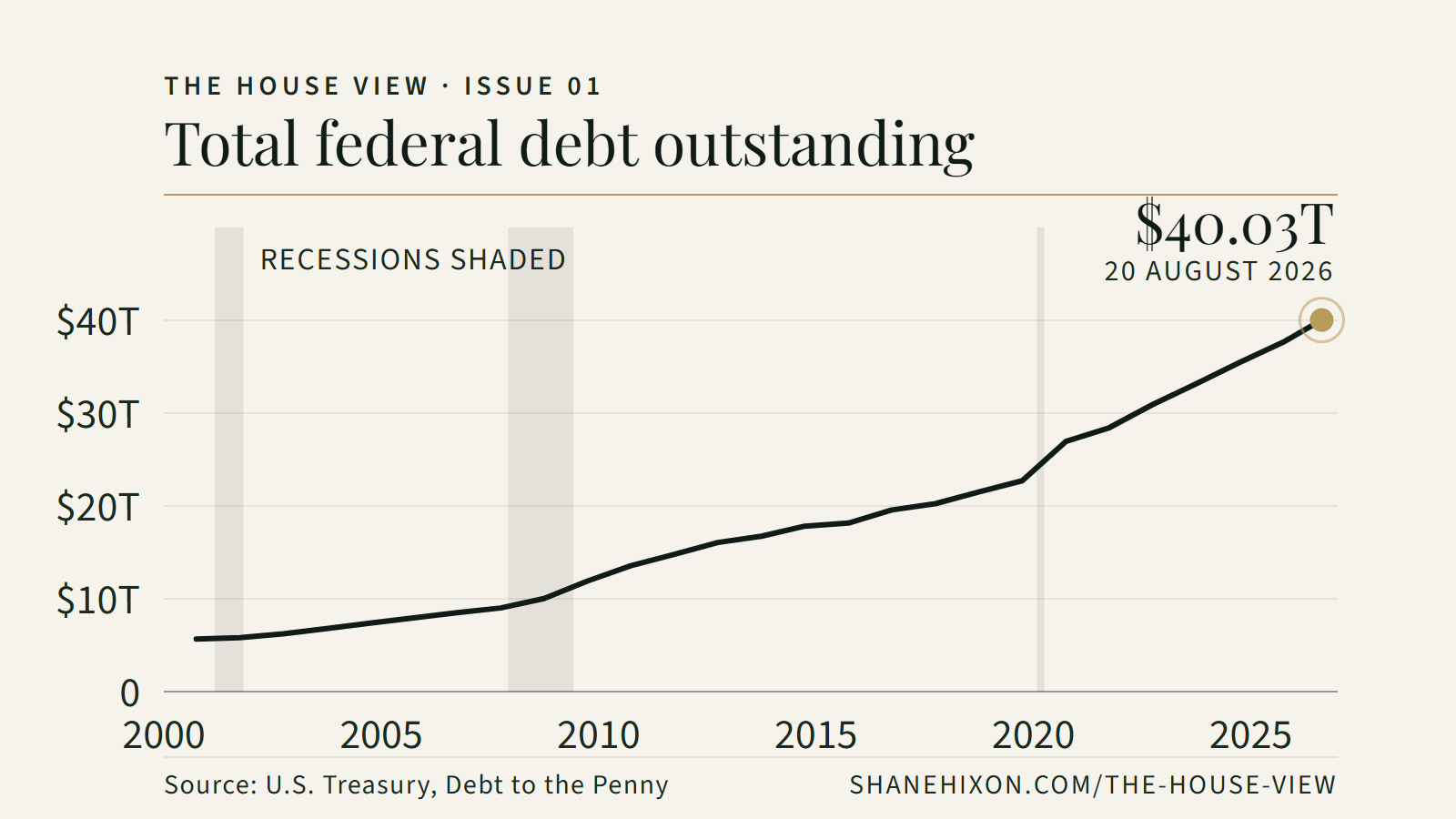
On August 20, the Treasury recorded total federal debt of $40.033 trillion. Of that, $32.279 trillion was held by the public. The country moved from $39 trillion to $40 trillion in roughly five months, and the total has more than doubled in less than a decade.
The United States can still borrow. A default is not our base case. The dollar remains the leading reserve currency, and Treasury securities remain the foundation of global finance. The concern is the price of that privilege and how quickly the country’s margin for error is shrinking.
CBO projects a $1.9 trillion federal deficit this year, equal to 5.8% of GDP, despite an economy that is not in recession. Debt held by the public is projected to reach 101% of GDP in 2026 and 120% by 2036. Net interest costs are expected to rise from about $1.0 trillion this year to $2.1 trillion in 2036. By then, interest would consume nearly one-fifth of federal spending.
That is the real problem. Debt does not have to trigger a sudden crisis to weaken an economy. It can do damage slowly by raising borrowing costs, crowding out private investment and limiting the government’s ability to respond to the next recession, war or emergency. Higher rates also feed the debt itself: as older securities mature and are refinanced, yesterday’s cheap borrowing is replaced with today’s more expensive borrowing, and the government issues more debt partly to pay interest on debt it already has.
Scott Bessent understands this market better than most Treasury secretaries. The former chief investment officer of Soros Fund Management features prominently in Sebastian Mallaby’s hedge fund history, More Money Than God. He built his career studying the point where government policy and market prices stop agreeing. Now he is on the government side of that argument.
After the 30-year Treasury yield climbed to a 19-year high near 5.3% this week, Treasury doubled the maximum size of liquidity-support buybacks in the 10-to-20-year and 20-to-30-year sectors from $2 billion to at least $4 billion per operation, beginning September 9. These buybacks are not quantitative easing, and they do not reduce the national debt. Treasury buys less-liquid older bonds while financing the government elsewhere. The operation can improve market plumbing, but it cannot fix the budget arithmetic.
The first market verdict was not reassuring. The 30-year yield fell after the announcement, then rebounded to roughly 5.24% on Thursday, only a few basis points below its pre-announcement level. Bessent said yields did not reflect the fundamentals and suggested Treasury’s toolkit could go beyond $4 billion.
This is where Bessent changes the equation. A skilled Treasury secretary can improve liquidity, adjust the maturity mix, prevent a technical accident and lower the risk premium by earning credibility. But there is a line between smoothing a market and trying to dictate its price. If larger buybacks arrive without a believable path to smaller primary deficits, investors may read the intervention as evidence that Treasury is more worried about long rates than it admits.
That is the More Money Than God test. It is not whether a gifted trader can move the world’s largest bond market for a day. It is whether the fiscal authority can convince that market it will not defend a price the budget cannot support.
Anthropic and the new generation of giant private companies belong in this story, but not because they caused the debt problem. They matter because they are competing for the same global savings.
Anthropic raised $65 billion in May at a $965 billion post-money valuation and said its annualized revenue pace had crossed $47 billion. Days later, it confidentially submitted a draft S-1, while making clear that no share count or price had been set. Reporting now suggests it may pursue an offering on a scale that rivals SpaceX’s record IPO.
The easy reading is that private investors are cashing in near the top. The more important reading is that even the deepest private pools may no longer be large enough to finance frontier AI. Compute, power, data centers and talent require capital on a scale once associated with governments. Public markets are being asked to fund that buildout while Treasury asks the same investors to absorb record sovereign borrowing.
There is a constructive version of this story. Productive AI investment could raise growth, expand the tax base and improve the denominator in the debt-to-GDP ratio, one of the few plausible ways the United States can grow into its obligations without relying entirely on higher taxes or lower spending. But the timing is mismatched: interest expense is real today, the productivity payoff is uncertain and arrives later, and at private valuations approaching $1 trillion, execution expectations are already extreme.
Sources
- U.S. Department of the Treasury, Debt to the Penny, August 20, 2026
- Congressional Budget Office, Budget and Economic Outlook
- U.S. Department of the Treasury, buyback operation announcement, August 19, 2026
- Anthropic, Series H announcement, May 28, 2026
- Sebastian Mallaby, More Money Than God