

For all the attention paid to artificial intelligence, interest rates and the future of the American economy, one of the oldest constraints on growth is making itself felt again: oil still has to move.
That distinction matters because the current energy shock is no longer just about the price of a barrel. It is increasingly about pipelines, refineries, shipping capacity and the cost of getting fuel from where it exists to where it is needed.
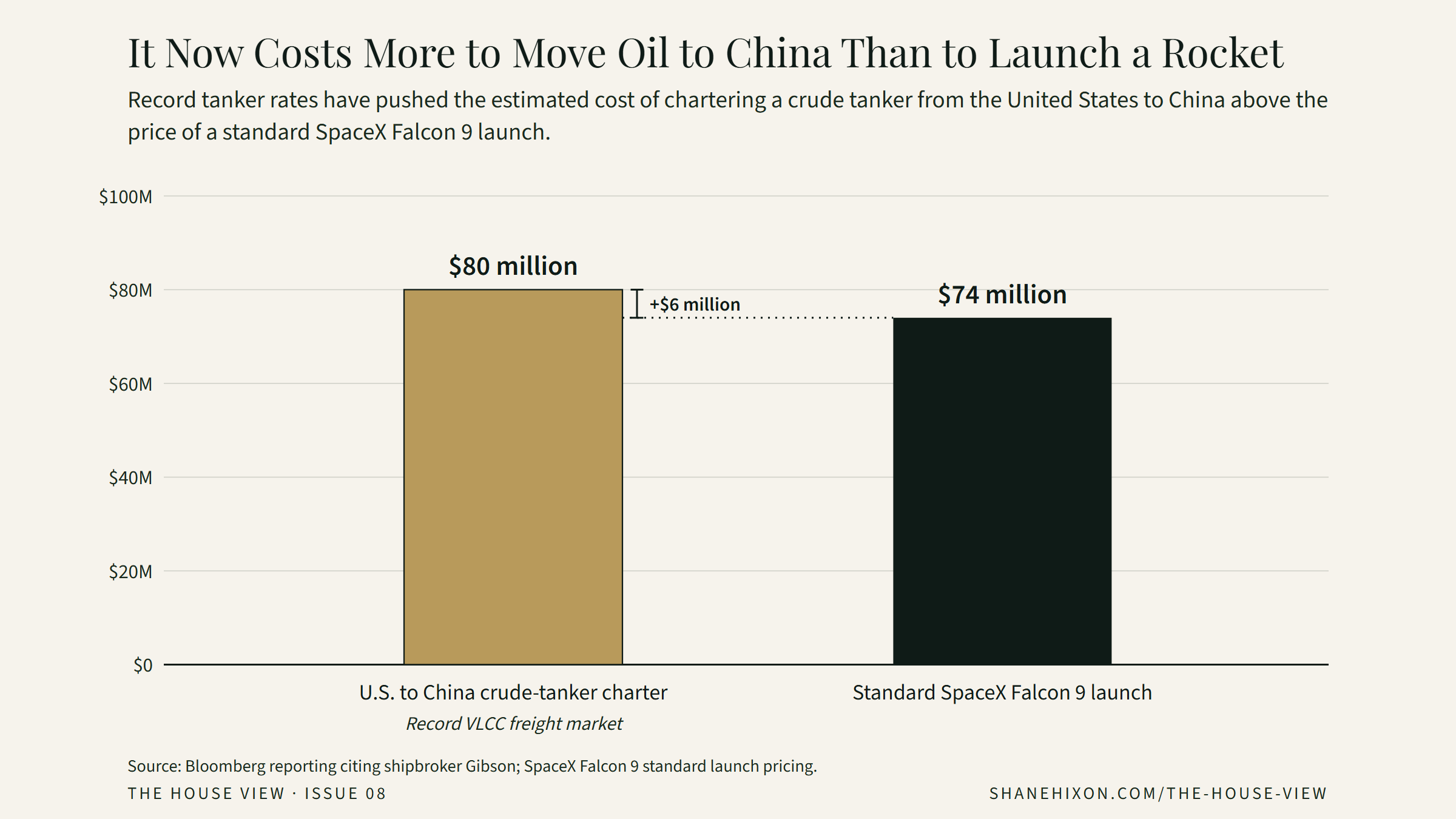
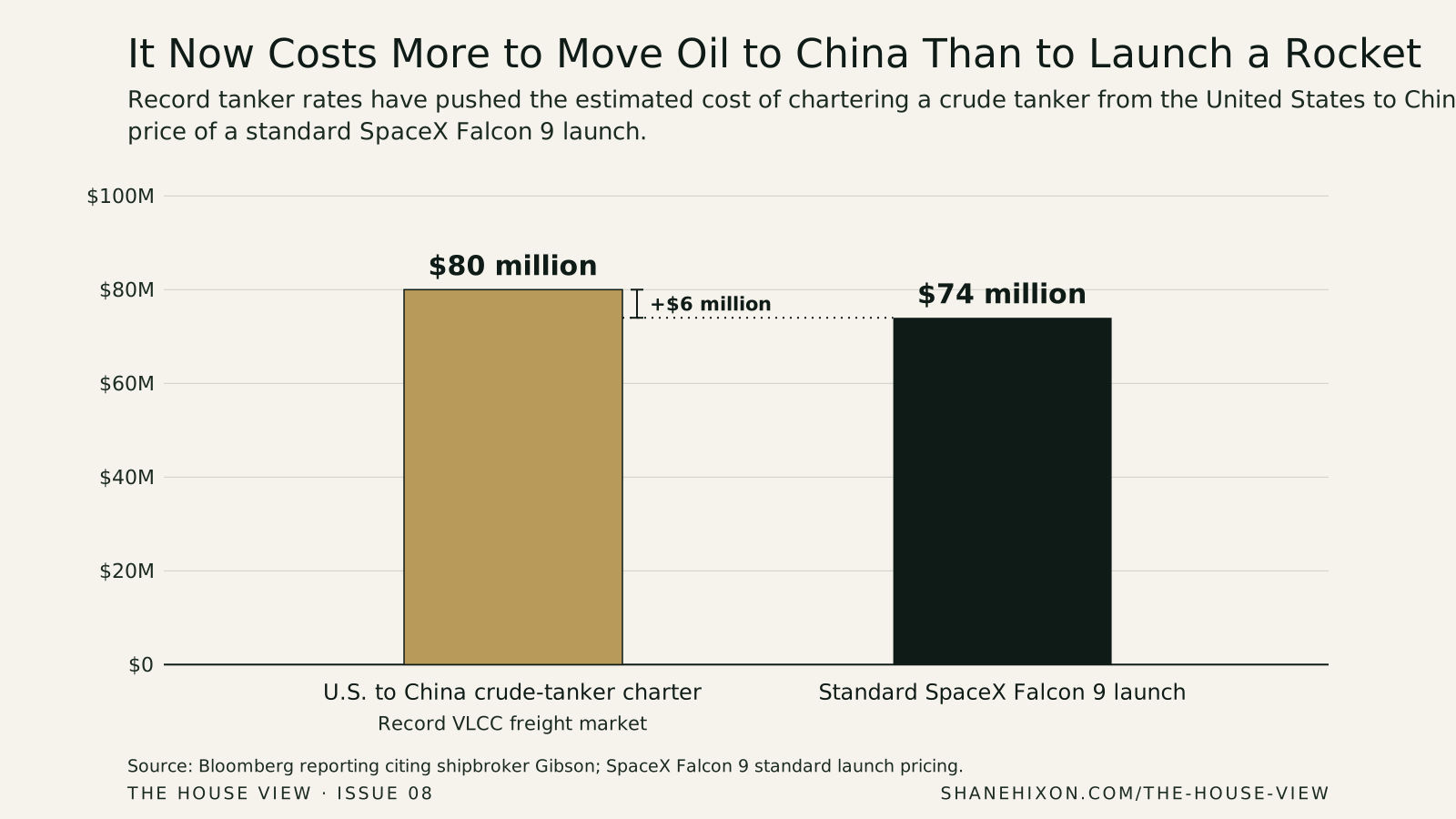
The clearest example may also be the most absurd. Hiring a crude tanker from the United States to China now costs roughly $80 million, according to shipbroker Gibson. A standard SpaceX Falcon 9 launch costs about $74 million. Moving a ship full of oil across the Pacific has become more expensive than launching a rocket into space.
That comparison is more than trivia. It is evidence of how stressed the physical energy system has become.

Show the data
| Item | Cost | Source |
|---|---|---|
| U.S. to China crude-tanker charter | $80 million | Bloomberg, citing shipbroker Gibson, October 9, 2026 |
| Standard SpaceX Falcon 9 launch | $74 million | SpaceX standard launch price, 2026 |
| Difference | $6 million | Calculated |
The tanker figure is an estimate. Reuters reported the same $80 million for a November charter, citing a different broker. SpaceX raised its standard Falcon 9 price from $69.75 million to $74 million in early 2026. Download the data as CSV or the chart as a scalable SVG.
On October 9, President Trump announced an agreement with Vladimir Putin that would allow Russian diesel back into American and global markets. Treasury simultaneously issued General License 135, temporarily authorizing transactions involving the sale, delivery, offloading and importation of Russian-origin diesel. Russia is expected to supply more than 300,000 metric tons immediately, another 500,000 tons in November and additional volumes thereafter.
The policy change is notable because the United States has spent years trying to restrict Russian petroleum revenues. Now energy prices are forcing another objective into the calculation.
The barrel is only part of the problem
The Energy Information Administration’s October outlook shows how quickly conditions deteriorated.
Brent crude averaged $114 per barrel in September, $23 higher than in August. After attacks disrupted Saudi Arabia’s East-West pipeline, Brent reached $131 on September 15. The pipeline matters because it allows Saudi oil to bypass the Strait of Hormuz and reach export terminals on the Red Sea. Before the disruption, the EIA estimates that more than five million barrels per day were moving through that route.
The EIA also estimates that global petroleum inventories declined by roughly 1.9 million barrels per day during the third quarter and expects another 700,000 barrels per day of withdrawals during the fourth. It now forecasts Brent to average about $105 during the fourth quarter, $14 above its forecast only a month earlier.
Forecasts can change quickly in an oil market driven by conflict. The inventory numbers are more important. Inventories are the buffer between a disruption and a shortage. When those buffers are large, the market can absorb lost production, delayed shipments or damaged infrastructure. When they are already falling, each additional interruption matters more.
The tanker market is showing the same strain from a different direction. Years of altered trade patterns, conflict around major shipping routes and the need to reposition vessels have created an extraordinary shortage of available tanker capacity. Very Large Crude Carrier rates have reached records, with some freight costs rising to roughly $41 per barrel and U.S.-to-China voyage costs approaching $80 million.
A barrel sitting at an export terminal is not the same economic product as a barrel delivered to a refinery. Transportation is part of supply, and when that transportation becomes scarce, the effective cost of energy rises even if the oil itself exists somewhere in the world.
Diesel is where oil enters the economy
Gasoline gets more political attention because almost every driver sees the price advertised from the road. Diesel works differently.
The EIA reported that U.S. retail diesel averaged $6.29 per gallon in September, compared with $4.35 for gasoline. The agency attributes the increase not only to higher crude prices but also to unusually wide refining margins caused by tight global distillate supplies.
Diesel powers trucking, agriculture, construction equipment, rail and parts of industrial production. A higher diesel price therefore enters the economy as an input cost before many consumers ever see it directly.
A trucking company facing a higher fuel bill can absorb the cost through lower margins, pass it through to customers or reduce activity. The farmer moving crops, the contractor operating heavy machinery and the retailer receiving merchandise face versions of the same problem. Eventually, some portion works its way into prices.
This is why an energy shock complicates monetary policy. The Federal Reserve can restrain demand by making credit more expensive, but it cannot repair a Saudi pipeline, increase refinery output or produce another fleet of supertankers. Higher energy prices can therefore weaken household purchasing power while simultaneously raising the cost of producing and transporting goods.
For investors, that combination is particularly uncomfortable. If the shock persists, growth can slow at the same time inflation remains elevated.
Washington turns to Moscow
Against that backdrop, the Russian diesel agreement becomes easier to understand economically.
Trump said on October 9 that Russia had agreed to immediately supply more than 300,000 metric tons of diesel to the American and global market. He also announced another 500,000 tons for November and one million tons immediately afterward, with additional volumes dependent on the condition of Russian refining capacity.
The Treasury Department’s General License 135 gives the policy legal effect by temporarily permitting specified transactions involving Russian-origin diesel.
That represents a meaningful reversal. The economic logic behind energy sanctions is to restrict the revenue available to an adversary. The economic logic behind releasing more fuel into a tight market is to increase supply and reduce prices. Both objectives can make sense independently, but they become harder to pursue simultaneously.
Russian diesel entering the market could relieve some pressure on distillate supplies. It also creates additional revenue opportunities for a country whose energy sector Washington has spent years trying to constrain.
That is not primarily a political contradiction. It is a commodity-market constraint. Governments have more flexibility when energy is abundant and inexpensive. When supplies tighten enough, the cost of foreign-policy objectives becomes more visible to households and businesses.
Oil converts geopolitical decisions into prices.
The announcement is larger than the barrels
The immediate quantities are not large enough by themselves to resolve the shortage.
The first 300,000 metric tons represents roughly two million barrels of diesel. Relative to U.S. and global consumption, that is meaningful additional supply but not a fundamental change in the balance of the market. Analysts have accordingly questioned whether the announced volumes are sufficient to materially reduce retail prices on their own.
The market nevertheless reacted. Diesel futures fell sharply following Trump’s announcement as traders incorporated the possibility of additional Russian supply. That move reflects a change in expectations, not confirmation that the physical shortage has disappeared.
There is a second constraint as well: Russia has to produce the fuel. Russian refining capacity has itself been pressured by the war in Ukraine and strikes against domestic energy infrastructure. An announcement of millions of tons of future supply therefore matters less than actual refinery output, available ships and delivered cargoes.
That is the recurring theme of the current oil market. Nominal supply is not necessarily available supply. Production capacity, refining capacity, pipelines and ships all matter because the system only works when they connect.
What investors should be watching
There is a reasonable path toward relief.
Saudi export infrastructure is recovering. Middle Eastern producers have been finding alternative routes around damaged or constrained infrastructure. Governments are releasing inventories. Russia may restore diesel exports, and the EIA expects crude prices to decline as more supply returns to the market.
Its October forecast has Brent averaging approximately $84 per barrel in 2027, well below current levels. That forecast is not an unreasonable base case, but it assumes the physical system normalizes.
The risk is that it does not normalize quickly enough. Global inventories are already being drawn down. Refining capacity remains constrained in several regions. Tanker rates demonstrate that transportation itself has become scarce. Continued attacks on energy infrastructure or shipping routes could therefore keep the cost of delivered petroleum elevated even if crude production begins to recover.
That distinction matters across asset classes. For equities, sustained diesel and freight costs would pressure transportation, agriculture, manufacturing and consumer businesses differently depending on their ability to pass those expenses through. Energy producers and tanker owners can benefit from scarcity while their customers experience it as a margin problem.
For fixed income, a prolonged energy shock would complicate the path of inflation and therefore the path of interest rates.
The important question is not whether Brent closes higher or lower next week. It is whether the physical energy system is rebuilding enough spare capacity to make the next disruption less consequential than the last one.
Sources
- U.S. Energy Information Administration, Short-Term Energy Outlook, October 6, 2026.
- U.S. Energy Information Administration, Global Oil Markets, October 2026.
- U.S. Energy Information Administration, What Goes Into Diesel Prices?, September 18, 2026.
- U.S. Department of the Treasury, Office of Foreign Assets Control, General License 135, October 9, 2026.
- Reuters, Trump says Russia to supply diesel to US and global market, October 9, 2026.
- Bloomberg / Gibson Shipbrokers, U.S.-to-China VLCC freight costs, October 2026.
- The Wall Street Journal, diesel-market reaction to the Russian supply announcement, October 9, 2026.