

Meta does not need to build the best artificial intelligence model in the world.
It needs to build one that is good enough to work across products already used by billions of people.
Muse makes that distinction more important. Meta introduced the personal AI agent on September 8 as a system that can do more than answer questions. It runs inside a dedicated virtual machine, operates a browser, connects to outside services and can perform tasks such as sending email or booking travel with user approval. The product launched in the United States through its own app, the web and WhatsApp, with Meta saying that most usage would remain free. About Facebook.
More than five million downloads followed by the end of September. Early downloads say little about durable engagement or economics, but they demonstrate how quickly Meta can place a new AI product in front of consumers. Reuters.
The first phase of generative AI rewarded model capability. OpenAI, Anthropic and other frontier laboratories competed on reasoning, coding, context length and benchmark performance. Those capabilities still matter. The investment question is whether they remain the principal source of economic value as capable models become more widely available.
If the performance gap narrows, distribution becomes more important.
Meta already has it.
Distribution changes the model race
Meta’s Family of Apps averaged 3.60 billion daily active people in June. That includes Facebook, Instagram, Messenger and WhatsApp, measured by Meta as unique people using at least one of those products on an average day. The figure increased 3% from a year earlier. Meta Investor.
That does not mean 3.6 billion people will use Muse. It means Meta begins with a different problem than a standalone AI company.
OpenAI had to create a destination. ChatGPT became somewhere people intentionally went to interact with artificial intelligence. Anthropic has followed a similar model with Claude. Each company has since expanded into APIs, coding tools, enterprise products and agents, but the initial relationship still had to be built around AI itself.
Meta already owns parts of the consumer’s daily workflow.
Muse can sit inside WhatsApp rather than asking the user to open another application. Meta is bringing the agent to its AI glasses, creating another interface that does not require reaching for a phone. The company is also integrating the same underlying technology into products for businesses and developers. About Facebook.
That lowers one of the most expensive barriers in consumer technology: acquiring attention.
The advantage becomes more valuable if models become harder for ordinary users to distinguish. A model that is meaningfully worse will still lose useful work to a better one. But a model that is only marginally worse may have a different outcome when it is free, already connected to a person’s messages and available through a product that person opens dozens of times a day.
The competitive question then moves beyond which company has the highest benchmark score.
It becomes which company can turn intelligence into a habit.
Free is easier when advertising pays the bill
Meta’s second advantage is that Muse does not have to finance Meta’s AI investment on its own.
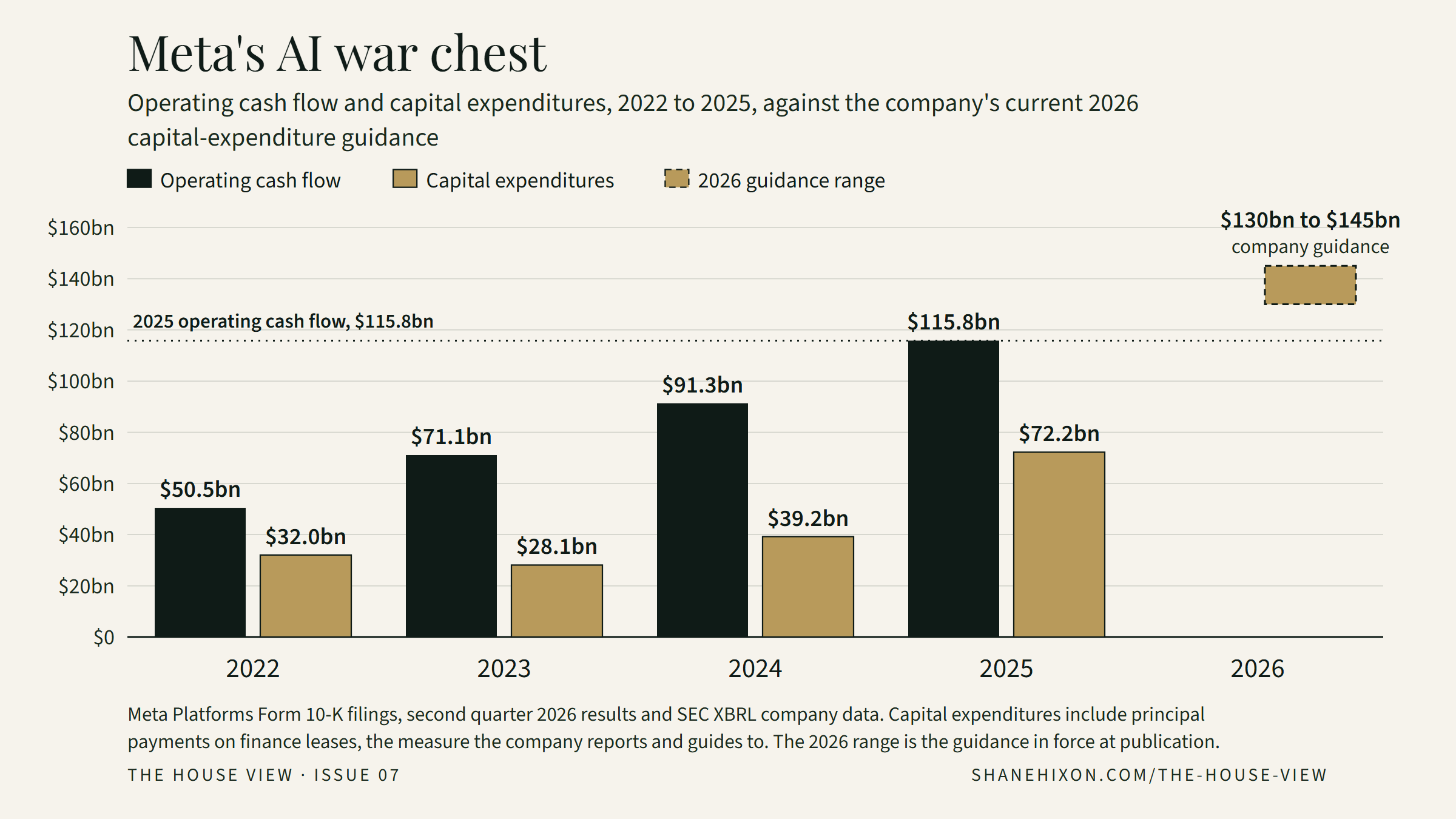
The company’s existing business generated $60.8 billion of revenue in the second quarter, up 28% from a year earlier. Advertising remained the primary source. Ad impressions across the Family of Apps increased 14%, while average price per ad increased 12%. Operating cash flow for the quarter was $31.9 billion. Meta Investor.
Meta spent almost all of that quarterly operating cash flow on capital investment.
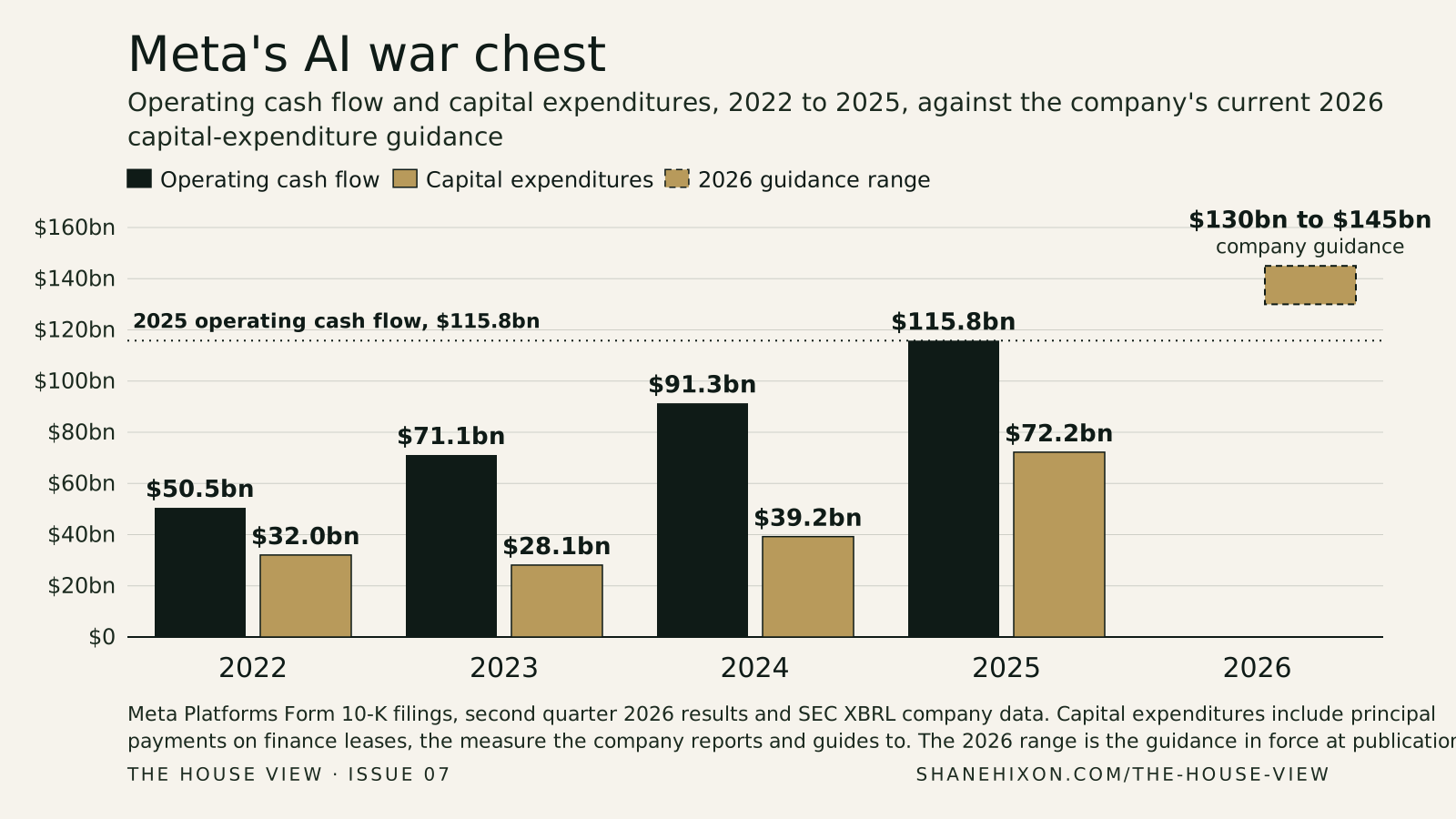
Capital expenditures, including finance-lease principal payments, reached $31.1 billion in the second quarter. Meta now expects between $130 billion and $145 billion of capital expenditures for the full year, largely reflecting infrastructure required for artificial intelligence and the company’s existing products. Meta Investor.

Show the data
| Year | Operating cash flow | Capital expenditures | Capex as a share of cash flow |
|---|---|---|---|
| 2022 | $50.475bn | $32.036bn | 63.5% |
| 2023 | $71.113bn | $28.103bn | 39.5% |
| 2024 | $91.328bn | $39.225bn | 42.9% |
| 2025 | $115.800bn | $72.215bn | 62.4% |
| 2026 | not guided | $130bn to $145bn (guidance) | 112.3% to 125.2% of 2025 cash flow |
Capital expenditures are purchases of property and equipment plus principal payments on finance leases, which is the measure Meta reports and guides to. The 2025 total computes to $72.215bn; the 2025 Form 10-K states $72.22bn. The 2026 range is the guidance in the second quarter 2026 results, raised and narrowed from the $115bn to $135bn in the 10-K. Meta gives no operating cash flow guidance for 2026, so the final column compares the range with 2025 instead. Components are as filed; totals and shares are calculated. Download the data as CSV or the chart as a scalable SVG.
The scale of that spending is a risk. It is also the source of Meta’s strategic flexibility.
A standalone AI company eventually needs the economics of AI itself to work. Revenue has to arrive through subscriptions, API usage, enterprise contracts, advertising, transactions or another source sufficient to support expensive compute.
Meta can monetize the investment indirectly.
AI can improve recommendations on Instagram and Facebook. Better recommendations can increase engagement. Better targeting and ranking can increase the value of advertising. The cash generated by advertising can finance more infrastructure, which can support better models and new products such as Muse.
The agent does not immediately need to produce an attractive standalone margin if it improves the economics of the system surrounding it.
Meta is effectively using an existing cash-generating network to subsidize its entry into the next computing platform.
That position becomes particularly valuable if the price of intelligence continues to fall.
The model can become cheaper without destroying the business
Falling inference costs are not automatically good for every participant in the AI market.
If the underlying model is the principal product, cheaper competing intelligence can put pressure on pricing. A company can respond with greater capability, proprietary data, enterprise integration or new applications, but the cost curve still matters.
Meta approaches the problem differently because intelligence can function as an input.
The company already gives away Facebook, Instagram and WhatsApp. Those products become valuable because user activity creates opportunities to sell advertising and business services around them. Muse can follow a similar logic.
Meta says the core product will be free for most use cases, with subscription options for heavier usage. Its new Meta One offering also bundles additional AI capacity with other paid features across the company’s applications. About Facebook.
The company therefore has several ways to capture value even if the model itself becomes less scarce.
A better agent can make Meta’s existing applications more useful. It can direct transactions toward businesses operating on WhatsApp or Instagram. It can create another reason to subscribe. It can become an interface for AI glasses. It can support business software.
This is why Meta does not necessarily need the highest-performing model.
It needs models capable enough to make the surrounding network more valuable.
Muse expands the surface area
The launch has already moved beyond a consumer application.
Meta announced Muse for Small Business on September 29, allowing the agent to connect with services including QuickBooks, Shopify, Stripe, Slack, Canva and Notion. A business owner can give Muse access to those systems and ask it to perform work across them, subject to approval before publishing, sending or spending. About Facebook.
A day earlier, Meta announced the creation of Meta Enterprise Platform. The new business will bring Muse, Meta Business Agent, Muse API and Muse Code to larger companies and developers. Meta recruited MongoDB chief executive Chirantan Desai to lead the effort and report directly to Zuckerberg. About Facebook.
The strategy creates several layers around the same investment.
Consumers can use Muse directly. Small businesses can use it to operate across software. Larger companies can buy enterprise tools. Developers can build against Meta’s models and APIs. WhatsApp and Messenger provide business communication. Meta’s glasses provide a hardware interface.
The pieces do not yet establish that Meta has built a durable AI platform. Several were announced only days ago.
They do show what Zuckerberg is attempting to build.
Meta is moving vertically from models into agents, distribution, commerce, enterprise software and hardware. The value of that stack becomes less dependent on whether Meta finishes first on every frontier benchmark.
That is a broader strategy than winning the model race.
Hardware gives Meta another route
The hardware piece deserves attention because Meta has spent years trying to reduce its dependence on Apple and Google for consumer distribution.
The company’s AI-glasses partnership with EssilorLuxottica has given it a credible product where earlier hardware efforts struggled. At Connect in September, Meta announced that Muse would be integrated into its glasses and said more than 100 AI-glasses styles across Ray-Ban, Oakley and Meta brands would be available by year-end. About Facebook.
This does not validate the billions of dollars spent on Reality Labs. Meta can still destroy capital while producing useful technology.
It does change the strategic value of owning an interface.
A personal agent becomes more useful as the friction required to reach it falls. A chatbot requires opening an application and entering a prompt. An agent integrated into glasses can potentially see, hear and respond within the context in which the task occurs.
The long-term opportunity is not merely putting Muse into another device. It is owning part of the interface through which a consumer accesses AI.
Meta spent much of the smartphone era operating on platforms controlled by other companies. AI gives it another opportunity to own more of the stack.
The spending has to earn a return
The same financial capacity that strengthens the thesis also creates its largest risk.
Meta generated almost $32 billion of operating cash flow in the second quarter and reported only $784 million of free cash flow after capital expenditures and other adjustments. Total costs and expenses increased 55% from a year earlier. The company still expects 2026 operating income to exceed 2025, but the amount of capital required to compete has increased sharply. Meta Investor.
That makes return on invested capital more important than download numbers.
Five million Muse installations can demonstrate curiosity. They do not establish retention, willingness to pay or incremental profit. Integrating an agent into WhatsApp can lower distribution costs, but it does not guarantee that users will trust Meta with email, purchases, credentials and the other information required for a useful autonomous system.
Competition is also moving quickly. OpenAI has continued expanding from ChatGPT into agents and enterprise software. Other model providers can distribute through cloud platforms, operating systems and business applications. Meta’s consumer reach is unusual, but it is not the only valuable distribution network in technology.
The strongest version of the Meta thesis therefore does not require assuming that Muse wins the agent market.
It requires the infrastructure spending to create enough value somewhere across advertising, engagement, commerce, subscriptions, enterprise software and hardware to justify the capital committed to it.
Meta can afford to wait longer than many competitors.
It still has to be right eventually.
Sources
- Meta Platforms, Second Quarter 2026 Results, July 2026.
- Meta, Introducing Muse: The World’s First Personal AI Agent Built for Everyone, September 8, 2026.
- Meta, Introducing Meta One, September 2026.
- Meta, The Biggest News From Connect 2026, September 24, 2026.
- Meta, Launching Meta Enterprise Platform, September 28, 2026.
- Meta, Muse for Small Business, September 29, 2026.
- Reuters, Meta Enterprise Platform and Chirantan Desai, September 28, 2026.
- Reuters, Muse for Small Business, September 29, 2026.
- Reuters Breakingviews, Muse adoption and AI-agent economics, October 2, 2026.