

The Federal Reserve raised interest rates on Wednesday. By Thursday’s close, the S&P 500 stood above its pre-decision level.
On September 16, the Fed unanimously increased its target range by a quarter percentage point to 3.75%–4.00%. Its statement described resilient spending, robust capital investment and elevated inflation. This was tightening against an economy the central bank still considered strong. Federal Reserve.
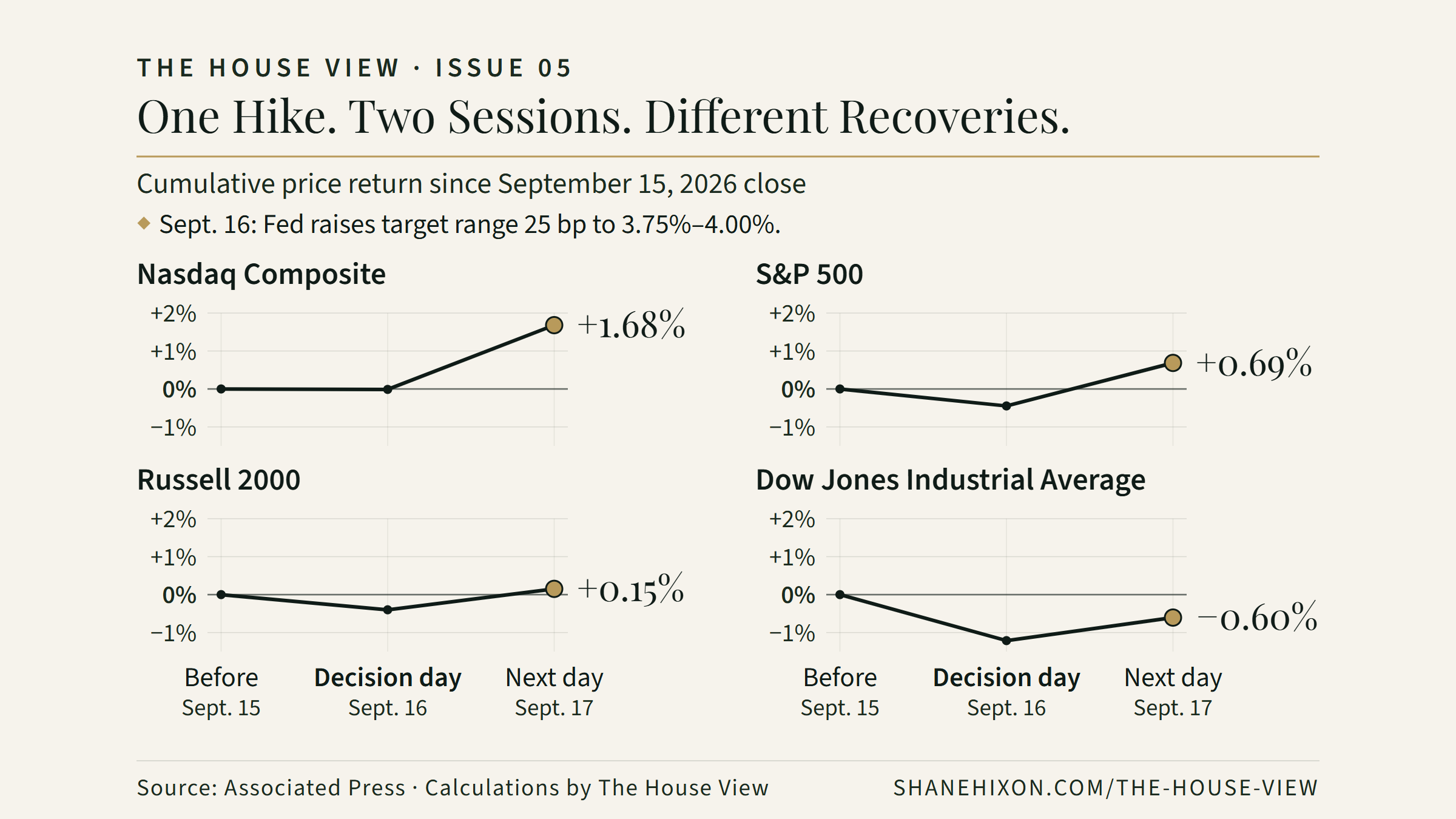
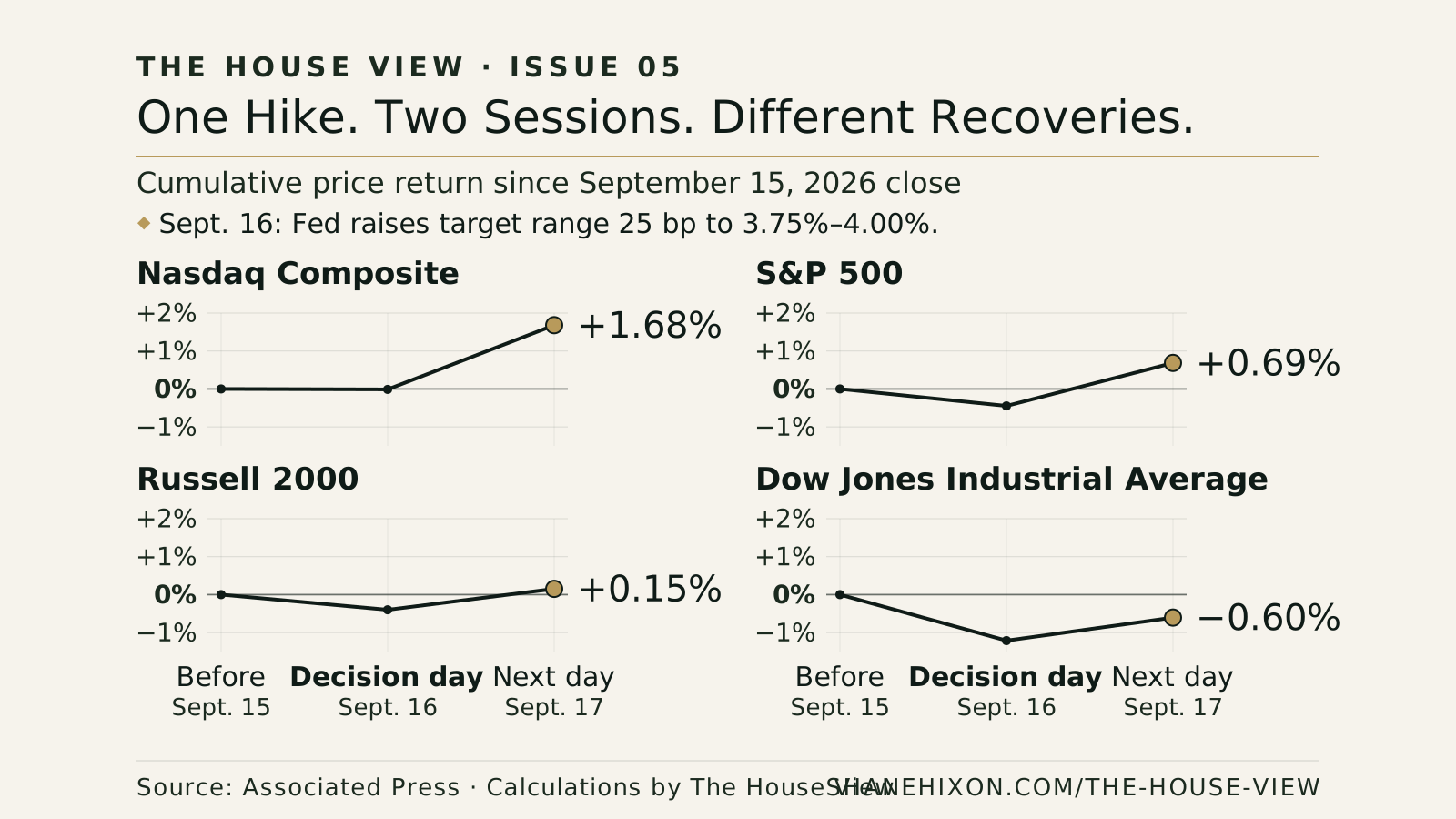
Stocks initially finished lower. The following session, the S&P 500 gained 1.1% and the Nasdaq Composite rose 1.7%. The Dow recovered only part of its Wednesday decline. Associated Press, September 16, September 17.
That sequence matters. Calling Thursday a rally “on the hike” compresses two different market reactions into one convenient explanation.
The more useful question is why financial markets found relief while monetary policy became tighter.
The Fed controls one rate. Investors price a path.
The federal funds target influences overnight borrowing. Stocks depend on expected earnings and the return investors require to hold them over many years. Treasury yields, credit spreads and equity risk premiums all enter that calculation.
Those prices can move differently from the Fed’s latest decision.
A rate increase that helps contain inflation could reduce the compensation investors demand for future inflation risk. It could also weaken expected growth, pulling longer-term yields lower for a less reassuring reason. The same direction in bond yields can carry very different economic messages.
Thursday brought a simpler, observable combination: equities rose, Treasury yields retreated and oil eased. Reuters reported that the ten-year yield fell roughly five basis points during the session, while Brent crude settled near $105 a barrel. Reuters.
Lower oil prices can relieve pressure on household budgets and business costs. Lower bond yields can support equity valuations. Both offered a counterweight to the increase in the overnight policy rate.
One session cannot tell us how much of the rally reflected confidence in the Fed, changing growth expectations or traders reversing positions. It can tell us that the hike was only one part of the information investors were processing.

Show the data
| Index | Sept. 15 close | Sept. 16 close | Sept. 17 close | Since Sept. 15 |
|---|---|---|---|---|
| Nasdaq Composite | 25,981.57 | 25,978.42 | 26,418.30 | +1.68% |
| S&P 500 | 7,585.73 | 7,551.81 | 7,637.76 | +0.69% |
| Russell 2000 | 2,870.28 | 2,858.81 | 2,874.63 | +0.15% |
| Dow Jones Industrial Average | 52,093.11 | 51,461.90 | 51,778.04 | −0.60% |
Daily closing levels from the Associated Press. AP does not publish the September 15 closes in either source, so each is reconstructed as the September 16 close plus the September 16 point decline AP reports: for the S&P 500, 7,551.81 + 33.92 = 7,585.73. Returns are (close / September 15 close − 1) × 100, price only, excluding dividends. The window is fixed through September 17. Download the data as CSV or the chart as a scalable SVG.
A green day is not the whole recovery
Measured from Tuesday’s close through Thursday’s close, the Nasdaq gained approximately 1.68% and the S&P 500 gained 0.69%. The Russell 2000 was barely ahead, while the Dow remained about 0.60% lower. These are calculated price returns from the reported closing levels. Associated Press, Wednesday closes, Thursday closes.
The distinction is useful. Every major index can rally on Thursday without investors having restored their pre-decision assessment of every part of the market.
It also limits the conclusion. Two sessions are too short to establish a durable rotation or prove that tighter policy has become harmless. Different index compositions produce different exposures to earnings expectations, financing costs and valuation changes.
For a profitable business that can finance investment internally, a modest rate increase may be manageable. For a business dependent on repeated refinancing or distant profits, the cost of capital remains consequential. A rising index does not remove that difference.
The investment question is whether earnings and cash generation can support valuations under the financing conditions that actually emerge.
Sources
- Board of Governors of the Federal Reserve System, Federal Reserve issues FOMC statement, September 16, 2026.
- Associated Press, How major US stock indexes fared Wednesday 9/16/2026.
- Associated Press, How major US stock indexes fared Thursday 9/17/2026.
- Reuters, world stocks and Treasury yields after the Fed and Bank of England decisions, September 17, 2026.