

Anthropic reportedly wants investors to contemplate an artificial-intelligence market worth more than $30 trillion a year. That number is roughly the scale of annual U.S. economic output.
The figure is a total addressable market, or TAM. In other words, it is the theoretical annual revenue opportunity if AI eventually touches an enormous share of global work and one provider somehow captures all of it. TAM is not a forecast. At this scale, it is closer to a statement about the economy than a useful estimate of one company’s future sales.
But the timing of the claim matters.
One day after the Wall Street Journal reported Anthropic’s $30 trillion pitch, Salesforce and Nvidia both released earnings after the August 26 close. The following session, Salesforce rose 22.6%, Nvidia gained 8.7%, the IGV software ETF advanced 7.7%, and the SOXX semiconductor ETF rose 1.9%.
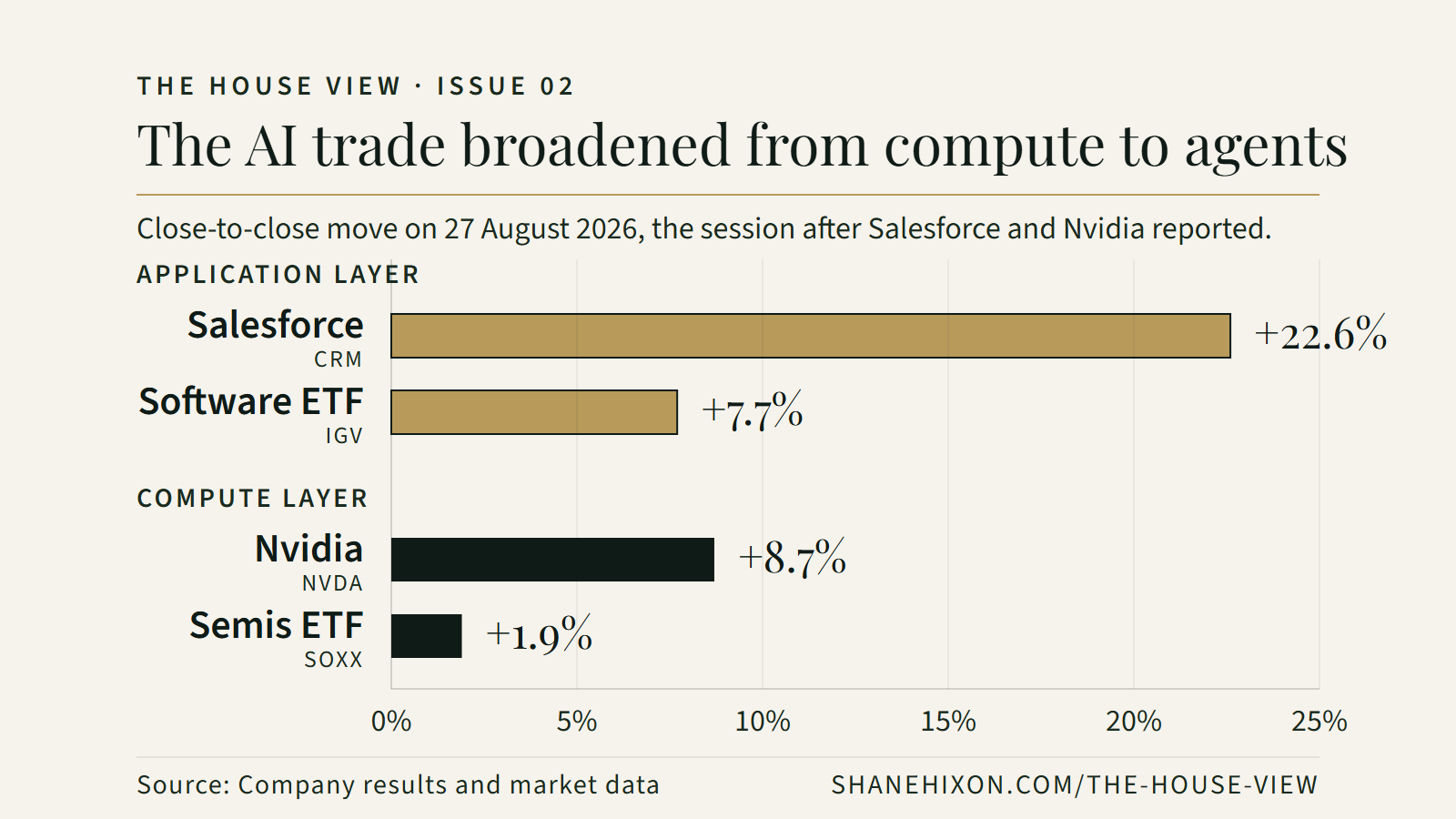
The rally was not simply another Nvidia beat. It was simultaneous validation from two different layers of the AI stack.
Nvidia proved the infrastructure demand is still real
Nvidia reported quarterly revenue of $96.2 billion, up 106% from a year earlier. Data Center revenue reached $89.0 billion, up 117%. Management guided to approximately $108 billion of revenue for the next quarter while assuming no Data Center compute revenue from China.
The market’s reaction was understandable. Nvidia is no longer being valued as an ordinary semiconductor company. It has become the toll collector for an infrastructure buildout that is increasingly measured against national power capacity, cloud capital budgets, and the financing needs of entire industries.
The important line from Jensen Huang was not that AI is exciting. It was that AI tokens are becoming productive and profitable. If that is true, compute demand is no longer supported only by experimentation. It is supported by customers expecting an economic return.
That is the strongest defense of the current buildout.
It is not a complete defense. Nvidia’s results prove that its customers are still buying. They do not prove that every customer will earn an adequate return on those purchases. Infrastructure revenue can remain exceptional even while capital is misallocated elsewhere in the system.
Salesforce may have delivered the more important signal
For much of the year, the bear case for software was simple: AI agents would not merely improve software. They would replace parts of it, weaken traditional interfaces, and reduce the value of the application layer.
Salesforce’s quarter pushed back against that view.
Revenue reached $11.3 billion, current remaining performance obligation grew 14%, and the company raised full-year revenue guidance. More importantly, Agentforce and Data 360 annual recurring revenue approached $3.9 billion, up more than 210% from a year ago. Agentforce ARR exceeded $1.5 billion, up more than 240%, while quarterly Agentic Work Units grew 97% from the prior quarter.
Those metrics do not prove that agentic AI has transformed Salesforce’s organic growth profile. Agentforce’s reported scope now includes additional AI offerings, Slackbot, and Headless 360. Salesforce’s $5.90 non-GAAP earnings per share also included a $2.53 benefit from gains on strategic investments. The headline was cleaner than the underlying economics.
Still, the market did not need perfection. It needed evidence that agents could become a paid product inside an incumbent software platform rather than simply a threat outside it.
Salesforce delivered that evidence. Its expanded Anthropic partnership, including Claudeforce, reinforces the strategy: let frontier models provide intelligence while Salesforce controls the customer data, workflows, permissions, and distribution required to turn that intelligence into enterprise work.
That is why Salesforce’s 22.6% move matters. It did not chronologically lead Nvidia, because both companies reported the same evening. It led the next day’s rally in magnitude and broadened the AI trade from compute into applications.
What Anthropic is really selling
The reported $30 trillion figure should be treated skeptically. It is too broad to discipline a valuation and too distant to function as a forecast.
But it is not random.
Anthropic is preparing investors to value the company as infrastructure for a meaningful share of global knowledge work, not as another software vendor. The number anchors expectations before a potential public offering, makes enormous compute requirements appear proportional to the opportunity, and signals that Anthropic intends to compete across industries rather than within a narrow product category.
There is also a competitive motive. SpaceX reportedly framed its own opportunity around a $28.5 trillion TAM. Anthropic’s larger figure is partly an attempt to win the narrative before investors begin allocating capital among multiple generational stories.
The Claudeforce partnership shows the more credible route to that ambition. Anthropic does not need to own every enterprise workflow if Claude can be embedded inside the platforms that already do.
The $30 trillion number is therefore best understood as a negotiating anchor, not an operating forecast.
Sources
- The Wall Street Journal, report on Anthropic’s addressable market
- NVIDIA Corporation, quarterly results, August 26, 2026
- Salesforce, Inc., quarterly results, August 26, 2026
- Market data for the August 27, 2026 session