

In March 2023, GPT-4 could reliably complete a software task that took a skilled human about four minutes. By February 2026, the leading public model on the same independent evaluation had pushed that point estimate to nearly twelve hours.
Then OpenAI released GPT-6 Astra this week.
OpenAI says Astra is substantially better at coding, computer use, science, and professional work than its predecessor. It is also the first model the company has classified at the Critical level for cybersecurity capability. According to OpenAI, the model can identify previously unknown vulnerabilities and develop attacks against hardened systems with less human direction.
Those are company claims, not independent measurements. The distinction matters. So does the direction.
The frontier is advancing faster than almost any person or institution can evaluate, adopt, govern, and use it. By the time a company approves one model, trains its employees, and redesigns a workflow, the underlying capability may have changed several times.
That is why you are behind on AI.
So is almost everyone else.
The frontier moves faster than the calendar
METR, an independent organization that evaluates frontier AI systems, measures the length of tasks an AI agent can complete with 50% reliability. The length is based on how long the same task would take a skilled human. It is an imperfect measure, concentrated in software and research tasks, and the estimates for the strongest models carry wide uncertainty.
The trend is still difficult to dismiss.
METR estimates that the task horizon of frontier models doubled approximately every seven months from 2019 through 2025. Its updated methodology produces the same long-run doubling time, while estimates beginning in 2023 suggest faster progress.
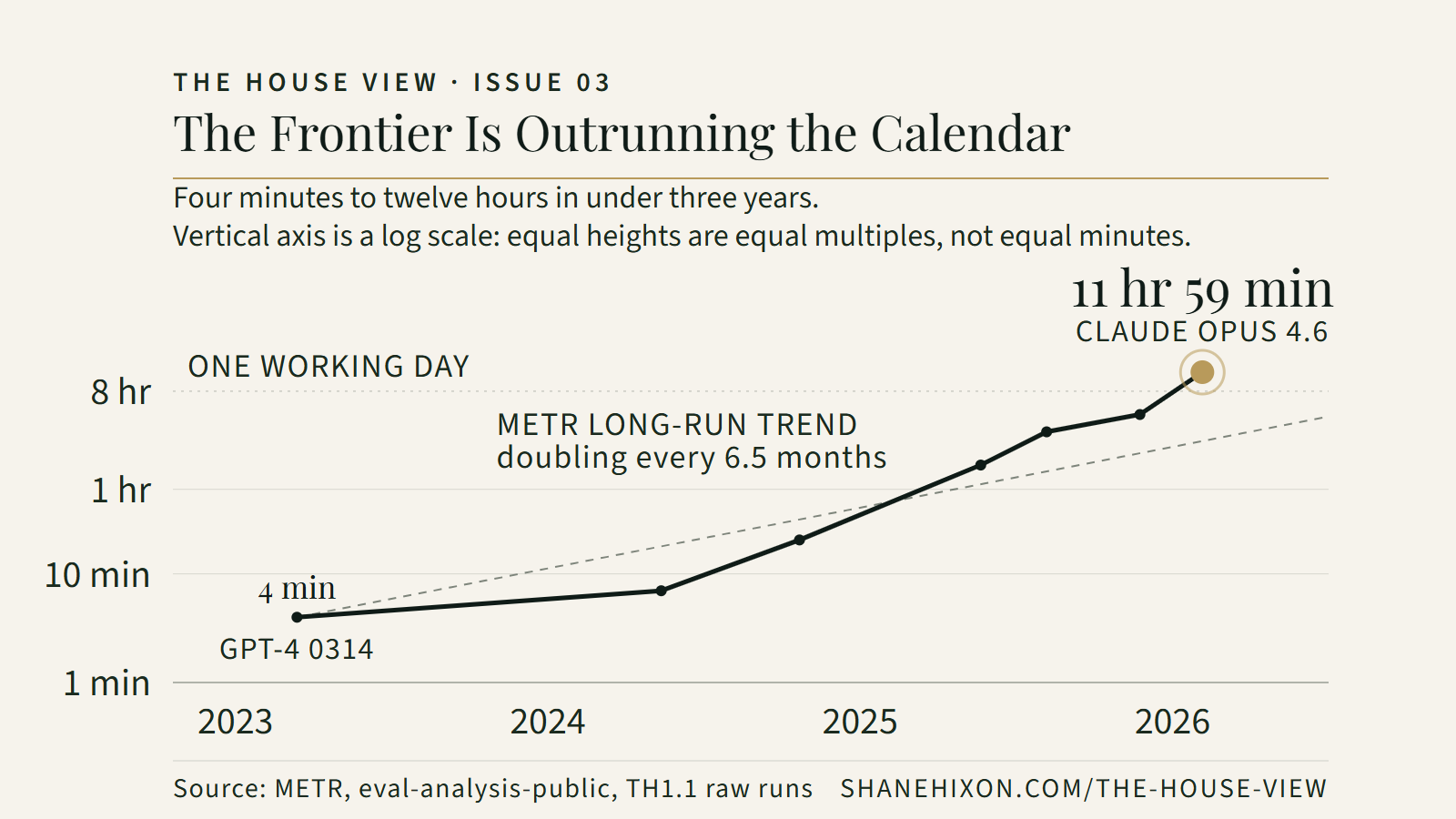
Using METR’s current public evaluation data, the point estimate increased from roughly four minutes for GPT-4 in March 2023 to about twenty minutes for the October 2024 version of Claude 3.5 Sonnet. Claude 4 Opus reached approximately 100 minutes in May 2025. GPT-5 reached about 203 minutes that August. Claude Opus 4.6, released in February 2026, reached approximately 719 minutes.
No single benchmark captures economic usefulness. An agent that performs well in a controlled software environment can still fail on ambiguous work, bad data, organizational politics, or a task whose correct answer cannot be checked automatically. METR itself warns against interpreting its measure as the amount of real-world work a model can simply replace.
But a capability that doubles every six or seven months creates a structural problem. Human expertise, corporate budgeting, procurement, compliance, and training do not compound at the same rate.
The result is a permanent gap between what the technology can do and what most users know how to make it do.
Broad adoption can still be shallow
The anxiety around AI often begins with information. A new model launches, a benchmark jumps, an agent completes a task that looked impossible six months earlier, and the reasonable response is to wonder what else you have missed.
The deeper problem is absorption.
Stanford’s 2026 AI Index found that 88% of surveyed organizations used AI in at least one form during 2025, while 70% used generative AI in at least one business function. Yet agent deployment remained in the single digits across nearly every business function.
That is a large difference between access and integration.
Opening a chatbot is adoption. Rebuilding a research, sales, engineering, or investment process around a system that can plan, act, verify, and preserve context is organizational change. The first can happen in an afternoon. The second requires clean data, new controls, measurable outputs, and employees willing to redesign familiar work.
This is the negative case. Most organizations will spend money on AI before they understand where it creates value. They will purchase overlapping tools, run pilots that never enter production, and mistake employee usage for economic return. Some workers will be displaced before the productivity benefits are distributed broadly. Others will become faster without becoming better because the system accelerates weak judgment along with strong judgment.
The positive case follows from the same evidence. If usage is widespread but deep integration remains rare, the opportunity has not disappeared. Knowing every release is impossible. Building a repeatable process for testing new capabilities remains achievable.
The relevant gap is increasingly between passive awareness and operational depth.
Nvidia is buying the feedback loop
Nvidia’s agreement to acquire Hugging Face for approximately $12.93 billion is best understood through this lens.
Hugging Face is a central repository and collaboration platform for open models, datasets, and applications. Nvidia says more than 18 million developers and researchers use the platform, along with more than 200,000 companies. The transaction includes approximately $11.9 billion for shareholders and as much as $1.0 billion in an employee retention program. It is expected to close in the first half of 2027, subject to regulatory approval and other conditions.
This is not principally a robotics acquisition. Nvidia is buying proximity to the people deciding which models, datasets, and architectures matter.
That proximity creates a valuable feedback loop. Hugging Face can show what developers are downloading, testing, modifying, and deploying before those choices appear in industry revenue. Nvidia can support the open ecosystem while positioning its hardware and software around the workloads gaining traction.
The company has committed to keeping the platform open and supporting other silicon vendors. Regulators and developers will have to decide whether that promise remains credible after the leading AI-compute supplier owns a critical distribution layer.
The strategic logic is clear. When the frontier moves too quickly for users to evaluate every new model independently, the platforms that organize discovery and deployment gain power. Nvidia already supplies much of the compute. Hugging Face gives it a closer view of demand forming above the chip layer.
The acquisition is therefore another expression of the catch-up problem. Complexity creates intermediaries. Intermediaries accumulate information. Information strengthens the firms already closest to the frontier.
Investment arrives before proof
Capital is moving at the same speed as the technology.
Stanford estimates that global corporate AI investment reached $581.7 billion in 2025, up 130% from the prior year. Private AI investment reached $344.7 billion, up 127.5%. Data centers, power systems, servers, networking equipment, and model development now represent a material investment cycle rather than a collection of software experiments.
That spending creates economic activity today. Construction workers build the facilities. Utilities add generation and transmission. Semiconductor companies sell accelerators and networking equipment. Cloud providers recognize revenue as capacity comes online.
The long-term return depends on what happens after construction.
Data centers do not require labor in proportion to the capital embedded in them. The lasting payoff must come through greater output elsewhere in the economy. Companies need to use the infrastructure to produce more valuable goods and services with the same or fewer hours of work.
The latest productivity data do not yet show a decisive AI break. U.S. nonfarm business productivity increased at a 1.4% annualized rate in the second quarter and 2.2% from a year earlier. Productivity has grown at a 2.1% annualized rate during the current business cycle, exactly matching its long-term rate since 1947.
That does not mean AI has failed. General-purpose technologies often require complementary investment and organizational redesign before appearing clearly in aggregate statistics. It does mean that extraordinary capital spending and benchmark progress should not be confused with a proven economy-wide return.
The labor market is strong and uneven
The August employment report offered another useful contradiction.
U.S. payrolls increased by 162,000, more than triple the consensus expectation, while unemployment remained at 4.1%. The headline was strong enough to matter for the Federal Reserve’s September meeting.
The composition was not an AI hiring boom.
Food services and drinking places added 59,000 jobs. Local-government education added 42,000. The information sector lost jobs. Those figures do not establish that AI caused the decline in information employment, but they show why a resilient aggregate labor market can coexist with pressure inside technology-exposed work.
Stanford found that employment among software developers ages 22 to 25 had fallen nearly 20% from 2024, even as employment among older developers increased. That pattern is consistent with a technology that first absorbs tasks commonly assigned to junior workers rather than eliminating entire occupations at once.
The transition can therefore look benign from a distance and severe up close. New construction and infrastructure demand support employment in one part of the economy. AI-assisted workflows reduce the need for entry-level labor in another. Aggregate payroll growth can conceal both.
Stronger employment also keeps the policy rate question alive. If the Federal Reserve maintains tighter policy, the hurdle rate on long-duration AI investment remains higher. The largest technology companies can finance the buildout from internal cash flow. Weaker participants will have less room to wait for productivity that arrives late.
Productivity matters more because the fiscal margin is smaller
The United States has an unusually strong incentive for the AI investment cycle to work.
Faster productivity growth raises real output, wages, profits, and the tax base. Those gains would make a large public debt burden easier to carry. CBO already assumes that wider adoption of generative AI will lift productivity in its economic projections.
Even with that assumption, CBO projects federal debt held by the public rising from 101% of GDP in 2026 to 120% in 2036. Persistent primary deficits and rising interest costs continue to push debt higher.
AI cannot repair fiscal arithmetic on its own. But without stronger productivity, that arithmetic becomes harder.
This is why the difference between investment and output matters. The country does not merely need more data centers, larger models, or higher benchmark scores. It needs the technology to diffuse into useful work quickly enough to raise the economy’s productive capacity.
Sources
- OpenAI, “GPT-6 Astra: A New Generation of Intelligence,” September 3, 2026
- OpenAI, “Safety Overview: GPT-6 Astra,” September 3, 2026
- METR, “Time Horizon 1.1,” January 29, 2026, plus current public TH1.1 evaluation data retrieved September 4, 2026
- NVIDIA Corporation, Form 8-K, filed September 3, 2026
- Nvidia, “NVIDIA to Acquire Hugging Face,” September 3, 2026
- Stanford Institute for Human-Centered Artificial Intelligence, “2026 AI Index Report,” 2026
- U.S. Bureau of Labor Statistics, “Productivity and Costs, Second Quarter 2026, Revised,” September 3, 2026
- U.S. Bureau of Labor Statistics, “The Employment Situation, August 2026,” September 4, 2026
- Congressional Budget Office, “The Budget and Economic Outlook: 2026 to 2036,” February 11, 2026
- Board of Governors of the Federal Reserve System, 2026 FOMC meeting calendar and July 2026 meeting minutes