

The American economy is still growing. The more interesting question is who is keeping it growing.
On Wednesday, the Federal Reserve released its October Beige Book, a collection of economic observations gathered across its twelve regional districts. Unlike the usual government reports, which tell us how much consumers spent or how many jobs were added, the Beige Book offers a look at what businesses are actually experiencing. The Fed speaks with employers, retailers, manufacturers, bankers, and other contacts to understand what is happening before it becomes visible in the broader data.
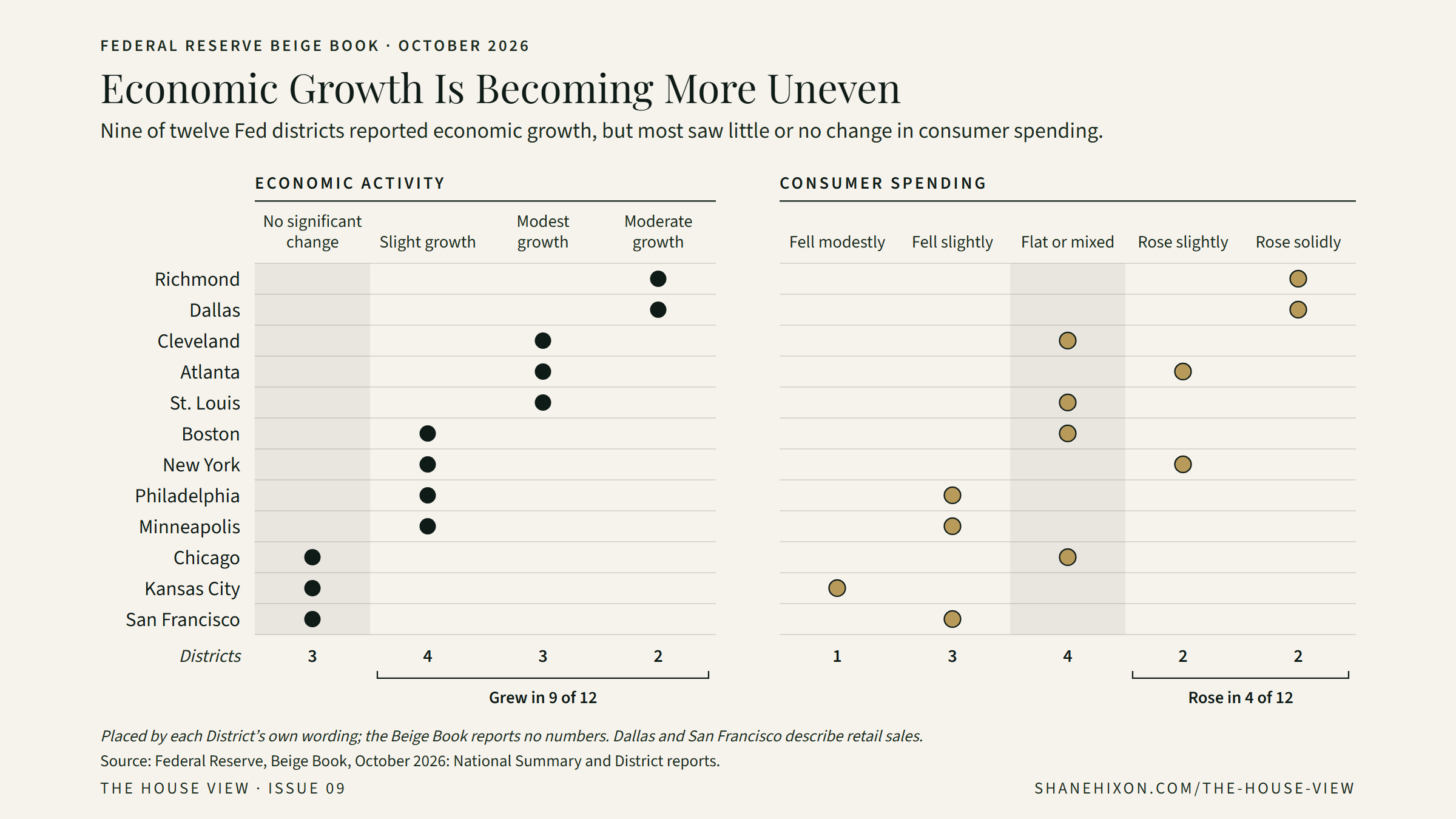
The latest edition describes an economy that remains surprisingly resilient, but that resilience is becoming increasingly uneven. Nine of the twelve districts reported some economic growth, yet most reported little or no change in consumer spending. More than half specifically noted that higher-income households were driving spending activity.
That distinction deserves more attention than the headline growth figures. An economy can continue expanding even as a growing portion of its population becomes more cautious. Aggregate spending measures the total amount of economic activity, not how comfortably that activity is distributed across households. The difference between those two things is becoming harder to ignore.
The consumer is not one consumer
Consumer spending accounts for roughly two-thirds of American economic output. It is the foundation of the economy, but discussions about consumer strength often treat the population as though everyone shares the same financial circumstances. They do not.
Higher-income households typically own more financial assets, have greater access to credit, and spend a smaller percentage of their income on basic necessities. They are better positioned to absorb higher prices without dramatically changing their consumption habits. Lower-income households operate with considerably less flexibility. When gasoline, groceries, insurance, and housing become more expensive, something else often has to give.
The Beige Book captures this divergence across the country. Even in Dallas, where retailers reported solid sales, businesses described increasing caution among lower-income customers. In Cleveland, retailers continued to face weaker demand partly because of higher fuel prices. San Francisco reported softer retail sales, while consumer spending in Minneapolis declined slightly.
These observations do not establish that every lower-income household is struggling or that consumer demand is about to collapse. They suggest that the strength visible in aggregate spending data is not being experienced equally. A business serving financially comfortable households may continue raising prices and growing revenue, while another serving more price-sensitive customers faces resistance to even modest increases. Both businesses operate in the same economy, but their customers are experiencing very different versions of it.
Growth is becoming more selective
The October Beige Book reported moderate growth in two districts, modest growth in three, slight growth in four, and no significant change in the remaining three. Manufacturing was one of the stronger areas, with Dallas reporting broad-based growth and six additional districts reporting modest to moderate manufacturing expansion.

Show the data
| District | Economic activity | Consumer spending |
|---|---|---|
| Richmond | Moderate growth | Rose solidly |
| Dallas | Moderate growth | Rose solidly (retail sales) |
| Cleveland | Modest growth | Flat or mixed |
| Atlanta | Modest growth | Rose slightly |
| St. Louis | Modest growth | Flat or mixed |
| Boston | Slight growth | Flat or mixed |
| New York | Slight growth | Rose slightly |
| Philadelphia | Slight growth | Fell slightly |
| Minneapolis | Slight growth | Fell slightly |
| Chicago | No significant change | Flat or mixed |
| Kansas City | No significant change | Fell modestly |
| San Francisco | No significant change | Fell slightly (retail sales) |
Each placement follows the District’s own wording; the Beige Book reports no numbers. Dallas and San Francisco describe retail sales, and Philadelphia’s description comes from nonauto retailers. The CSV quotes every District’s sentence. Download the data as CSV or the chart as a scalable SVG.
That is encouraging, particularly given the energy disruptions and uncertainty businesses have faced throughout the year. But the composition of that growth matters. Demand associated with data centers, power generation, and defense spending is supporting portions of the manufacturing economy. These are substantial sources of investment, but they do not necessarily tell us much about the average household’s financial position.
The same economy can have a booming infrastructure sector and a struggling consumer-facing business. That does not make the growth artificial. Building a data center requires construction, electricity, equipment, labor, and financing. It produces real economic activity, but the question is how broadly those benefits spread. If capital investment continues accelerating while ordinary consumer demand stagnates, the economy becomes increasingly dependent on a narrower group of industries and households. This is not inherently unsustainable, but it changes the risks investors should be evaluating.
Productivity without hiring
Another finding in the Beige Book caught my attention. Five Federal Reserve districts reported that some businesses had reduced staffing through attrition, delayed hiring, or anticipated creating fewer jobs after increasing productivity through AI investment.
This is an early observation, not evidence that AI is causing widespread unemployment. Businesses have many reasons to slow hiring, including borrowing costs, weak demand, and uncertainty about future expenses. Still, it is an important development because much of the economic argument for artificial intelligence rests on improving productivity.
If a company can produce more with the same number of employees, its output per worker increases. That can improve margins, lower prices, or free resources for investment elsewhere. But productivity improvements do not automatically produce immediate employment growth. A business that previously needed ten additional employees to support expansion may discover that it only needs three. The business becomes more efficient, but the seven positions that might otherwise have existed never appear in employment statistics as layoffs.
Over time, productivity growth can create entirely new industries, increase real wages, and support higher living standards. That has been an important feature of previous technological transitions, but the timing matters. If businesses can expand output without expanding payrolls, employment income may grow more slowly than production. That creates another channel through which economic growth can become less evenly distributed, at least during the adjustment.
For investors, the distinction between productivity-driven earnings growth and demand-driven revenue growth is worth understanding. Both can improve profitability, but they tell us different things about the underlying economy.
Inflation makes the divide worse
The Beige Book also documented increasingly persistent cost pressures. Three districts described price growth as robust, eight reported moderate increases, and four indicated that the pace of price increases had accelerated since the previous reporting period.
Energy was a common concern across all twelve districts. Higher diesel prices were working through transportation and supply chains, while businesses also reported pressure from tariffs, insurance, and other operating expenses. Consumer-facing companies were finding it difficult to pass along all these costs. Customers were resisting price increases, forcing businesses to absorb part of the pressure through lower margins, promotions, or changes in the products they offer.
This creates a difficult environment for both businesses and households. A higher-income consumer might respond to more expensive groceries by buying the same products and saving a little less. A household with limited disposable income may have to reduce spending elsewhere entirely. The inflation rate can be identical for both households while its economic consequences are very different.
There is also a monetary policy problem. The Federal Reserve raised its policy rate in September, and September’s consumer price inflation subsequently reached 3.7% over the prior year. Higher interest rates can reduce borrowing and spending, but they do not directly repair damaged energy infrastructure or reverse geopolitical disruptions. The Fed is therefore dealing with an economy where the strongest sectors may still support growth while weaker consumers face both elevated prices and restrictive financing conditions.
Sources
- Federal Reserve, Beige Book: Summary of Commentary on Current Economic Conditions, October 14, 2026.
- Federal Reserve Bank of Cleveland, Fourth District Beige Book, October 14, 2026.
- Federal Reserve Bank of Minneapolis, Ninth District Beige Book, October 14, 2026.
- Federal Reserve Bank of Dallas, Eleventh District Beige Book, October 14, 2026.
- Federal Reserve Bank of San Francisco, Twelfth District Beige Book, October 14, 2026.
- Bureau of Labor Statistics, Consumer Price Index, September 2026, October 14, 2026.